Pressione Esc para fechar

El dispersor de tintas y barnices gráficos es un equipo industrial diseñado para descomponer aglomerados de pigmentos y homogeneizar resinas a alta velocidad. Esta solución es fundamental para garantizar el poder cubriente y brillo que requiere el mercado de la impresión gráfica, actuando directamente en la etapa de premolienda y dispersión fina.
La fabricación de compuestos de alta viscosidad requiere una precisión absoluta para evitar grumos e inconsistencias en el lote. Con 15 años de experiencia en el mercado de soluciones de agitación y mezclado industrial, Agimix desarrolla proyectos robustos que apoyan el régimen continuo de las industrias químicas, entregando un proceso de dispersión optimizado que reduce el tiempo de la máquina y aumenta la rentabilidad de la planta.
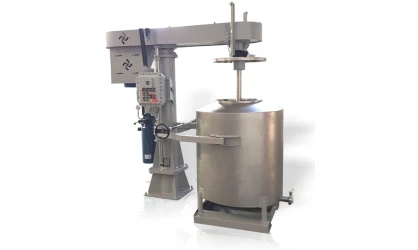
Para satisfacer esta demanda con la máxima eficiencia operativa, Dispersor con Hidráulico Lifting destaca como la opción ideal. Este equipo permite el cambio rápido de macetas, facilitando la producción por lotes de diferentes colores y formulaciones sin generar cuellos de botella en la línea de llenado.
El sistema de elevación de columna hidráulica brinda seguridad ergonómica a los operadores y permite el ajuste fino de la altura del disco dispersante durante el proceso. Esto garantiza la perfecta formación del vórtice, condición imprescindible para la incorporación de aditivos y cargas minerales en la producción de barnices y tintas de impresión.
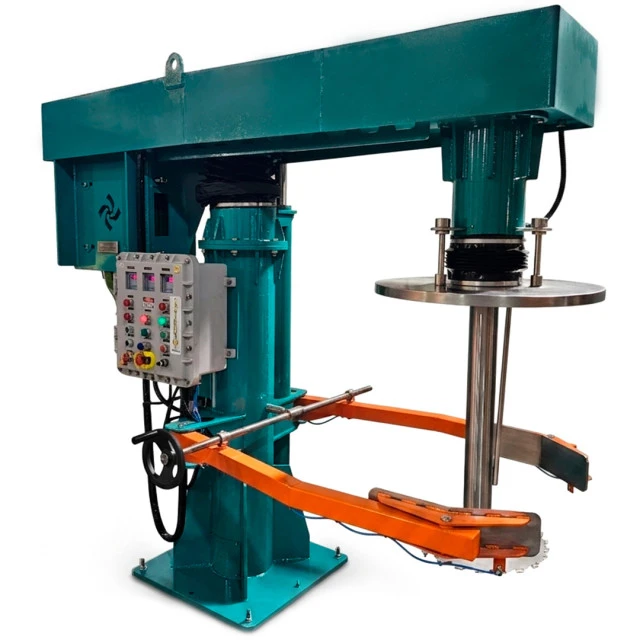
El diseño del disco cowles garantiza una desintegración extremadamente rápida de los aglomerados de pigmentos, lo que da como resultado pinturas con un brillo superior.
El uso del Dispersor con Elevación Hidráulica le permite cambiar rápidamente los platos, multiplicando la capacidad de producción diaria de su fábrica.
La estructura de columna reforzada y el sistema de elevación hidráulico eliminan las vibraciones excesivas y protegen al operador durante la manipulación.
Una predispersión eficiente reduce drásticamente la carga en los molinos, generando ahorro de electricidad y menor desgaste de los equipos.
Dimensionamos la potencia del motor y el diámetro del disco dispersor según la viscosidad específica de su barniz o tinta gráfica.
Estas especificaciones no son fijas para todos los equipos: son posibilidades disponibles en algunos de los modelos indicados. Consulte a nuestro equipo comercial para confirmar la información y la configuración ideal para su operación.
| Capacidad de Producción (Macetas) | 100 a 2.000 litros por lote |
| Material de contacto | Acero inoxidable AISI 304 o 316L |
| Tipo de impulsor | Disco dispersor tipo Cowles de alto cizallamiento |
| Sistema de elevación | Columna con accionamiento hidráulico automatizado. |
| Rotación del eje | Variable por inversor de frecuencia (típico de 500 a 1500 RPM) |
| Potencia del motor | 10 CV a 150 CV (dependiendo del volumen y viscosidad) |
| Aplicación principal | Producción por lotes de pinturas, barnices y productos químicos. |
| fijación de tacómetro | Sistema de garras ajustable en la base de la columna. |

Respuestas directas a las dudas más comunes sobre este equipo y su aplicación.
El dispersor industrial es un equipo de alto cizallamiento que se utiliza para mezclar resinas y descomponer aglomerados de pigmentos. Es la máquina principal en la etapa inicial de fabricación, asegurando que la pintura base alcance la finura adecuada antes de pasar por los molinos de microesferas.
El sistema funciona a través de una columna de elevación hidráulica que sube y baja automáticamente el conjunto de motor y eje. Esto permite al operador ajustar la altura del disco de dispersión según el nivel del producto en el recipiente, además de facilitar la extracción del recipiente una vez completado el lote.
La principal ventaja es la agilidad en la producción por lotes. Mientras se dispersa un lote en el Dispersor con Elevación Hidráulica, ahora se puede preparar otro recipiente con materias primas o llevar al área de llenado, eliminando tiempos de inactividad.
No, el equipo realiza la predispersión y homogeneización inicial de la formulación. Aunque se puede alcanzar un excelente grado de finura, las tintas gráficas con requisitos de brillo y cobertura muy altos todavía necesitan pasar por un molino para la molienda final de las partículas.
El eje y el disco dispersor están fabricados en acero inoxidable AISI 304 o 316L. Esta elección del material es obligatoria para evitar la contaminación de la pintura por oxidación y para resistir la abrasión severa provocada por cargas minerales y pigmentos duros.
El equipo utiliza motores de alta potencia combinados con un inversor de frecuencia. Esto permite que la máquina comience a girar suavemente y aumente gradualmente el torque, manteniendo la estabilidad del vórtice de mezcla incluso en formulaciones extremadamente viscosas.
Sí, el control de velocidad es totalmente ajustable a través del panel de control eléctrico. El operador puede cambiar la rotación del disco cowles en tiempo real para adaptarse a los cambios de viscosidad que ocurren a medida que se incorporan aditivos y pigmentos a la resina.
Los dispersores de columnas están diseñados para procesar volúmenes que normalmente oscilan entre 100 y 2000 litros por lote. El dimensionamiento exacto del equipo y del plato dependerá de la demanda de producción de su fábrica y de la densidad específica del producto químico.
Hable con nuestros ingenieros y descubra cómo nuestro dispersor industrial puede aumentar la calidad y la velocidad de su producción de pintura.
Solicitar cotización